If you run a small or family-owned car rental company, you've felt it: a customer calls, says, “actually, Enterprise had it for $10 less,” and hangs up. Or someone books a national chain not because it's better, but because the app was easier to find at 11pm than your phone number.
It's easy to read that as, “we can't compete.” You don't have a national ad budget, a fleet-buying discount, or an app development team.
But the businesses that win against Enterprise and Hertz at the local level are not outspending them. They are outmaneuvering them in places the big chains structurally cannot follow.
This is a practical playbook for doing exactly that.
Why bigger is not automatically better to your customer
National chains win on brand recognition and airport counters. That is hard to beat, and this is not a guide pretending you can out-brand Hertz.
But brand recognition is not the only thing renters are choosing on. For a large slice of your local market, it is not even the deciding factor.
Renters who have had a bad experience with a national chain remember it. Hidden fees. A bait-and-switch upgrade. An hour in line for a car that was not ready. Those moments create an opening.
They are not loyal to Enterprise. They are going with the default because nothing gave them a clear reason not to.
A quick scenario. Someone's car is in the shop for a week. They search “car rental near me.” Three results come up: two national chains and your listing with three stars, no photos, and a profile last updated two years ago.
Even if your price is better and your service is more personal, you may lose that renter before they ever speak to you. On the screen, you looked like the riskier choice.
This is the gap this guide closes. It is not about your actual service quality, which may already be your advantage. It is about whether that advantage is visible at the moment someone is deciding.
The advantages you already have that they structurally cannot copy
You can actually talk to your customers
A renter dealing with a national chain talks to whoever is behind the counter that day, often reading from a script, with limited authority to bend a rule.
A renter dealing with you can talk to you, the owner, or someone who knows the fleet and the customer.
That matters. It is the difference between “policy says no” and “let me see what I can do.”
You can be flexible in ways a corporate policy manual cannot
A delayed flight. A slightly different pickup time. A regular customer who needs a favor.
A national chain's local branch may not have the authority to make that call. You do.
Every time you use that flexibility well, you build loyalty that a rewards program cannot buy.
You can carry a fleet that actually fits your market
Trucks for a hardware-store crowd. Work vans for local contractors. SUVs that fit car seats. EVs for visitors who want to try one for a weekend.
You can specialize in what your town actually needs instead of running the same generic fleet as every branch nationwide.
You are the local business
People actively look for local businesses to support, especially after a bad experience with a faceless chain.
“Family-owned since 2009” is a real selling point, but only if a potential renter can see that before they book somewhere else.
You remember your regulars
A contractor who rents a truck every time a job needs one. A family that rents from you every summer. A local business that needs temporary vehicles during busy months.
You know them by name. You know what they need. You can take care of them in a way that does not scale at a national chain.
That relationship is worth more than a loyalty-points program because it is personal.
Where you're actually losing ground, and it is not price
When small operators lose bookings to national chains, it is rarely because the chain was dramatically cheaper.
It is usually one of these issues.
They are bookable in two taps, while you are only bookable by phone
A renter comparing options at midnight will book whichever one lets them finish the transaction right now.
If your business requires a call during business hours, you lose every after-hours search to whoever does not.
They look more official, even when your operation is more reliable
A polished booking confirmation, digital agreement, automatic ID check, and online payment flow signal professionalism.
A handwritten contract and a “call to confirm” process can feel risky to a first-time renter, even if your actual service is better.
They show up first on Google
If your Google Business Profile is thin, unclaimed, or has three reviews from 2021, a renter searching “car rental near me” may never scroll far enough to find you.
Even if you are two miles closer, you lose if your online presence looks neglected.
They make payment feel modern
Tapping a card into an app or checkout page feels current.
Writing a check, running a manual card swipe, or handling a cash deposit with a paper receipt can make a good business feel outdated.
None of these are about being outspent. They are about how you present a better local service.
The playbook: 6 moves that close the gap without a corporate budget
1. Make yourself bookable without a phone call
Every renter who has to call during business hours is a renter you might lose.
An online booking calendar, even a simple one, helps you capture the after-hours searcher instead of losing them to a national app.
Your booking flow should let renters:
- See available vehicles
- Choose dates and times
- Review pricing
- Submit renter details
- Pay online
- Receive confirmation automatically
2. Make your agreement and verification look as professional as the chains
A digital rental agreement with an e-signature and automated ID check does two things.
First, it protects your business. Second, it signals that your operation is legitimate and organized.
That signal matters. It can be the difference between “this looks legit” and “I'll just go with the name I know.”
3. Own your local Google presence
Claim and complete your Google Business Profile.
Add:
- Accurate hours
- Phone number
- Website or booking link
- Photos of your actual fleet
- Pickup details
- Service areas
- Reviews from real customers
- Fresh updates when your fleet changes
This is free, and it is one of the highest-leverage moves a local operator can make.
“Car rental near me” is exactly the search your ideal customer is already running.
4. Turn every good rental into a referral, not only a review
A national chain cannot call a happy customer personally and ask for a referral. You can.
After a good rental, send a short personal follow-up. Ask for a review or referral.
That simple habit compounds every month in a way a generic post-rental survey does not.
5. Say local out loud, everywhere
Do not assume people know you are the local, family-run option.
Say it on your booking page, Google listing, confirmation emails, and follow-up messages.
Use simple copy like:
Independently owned and serving [town] since [year]. Book local, skip the counter line, and work directly with a team that knows the fleet.
That is a real differentiator when it is visible at the exact moment someone is choosing between you and a chain.
6. Make payment feel as modern as the chains
Accepting cards through a proper payment processor closes the “this feels current” gap quickly.
It also means you are not chasing cash deposits, reconciling paper receipts, or manually tracking payments at the end of the week.
That is time you can put back into your fleet and customers.
What this looks like in practice
None of this requires ripping out how you already run things.
A practical rollout looks like this:
- Claim and complete your Google Business Profile this week.
- Add current photos of your actual vehicles.
- Turn on online booking and digital agreements.
- Add ID and insurance verification.
- Start asking every satisfied renter for a review or referral.
Nothing here requires downtime, a new hire, or a complicated staff rollout.
You are closing gaps one at a time, in the order that gives you the most visible win first.
What this actually costs to set up
This is where small operators often assume modernization means a five-figure software contract built for a 200-car enterprise fleet.
It does not have to.
Fleetwire starts at $24 per month, with a free tier to get your first vehicle live before you pay anything.
It is built for operators with a handful of cars, not only for companies with hundreds.
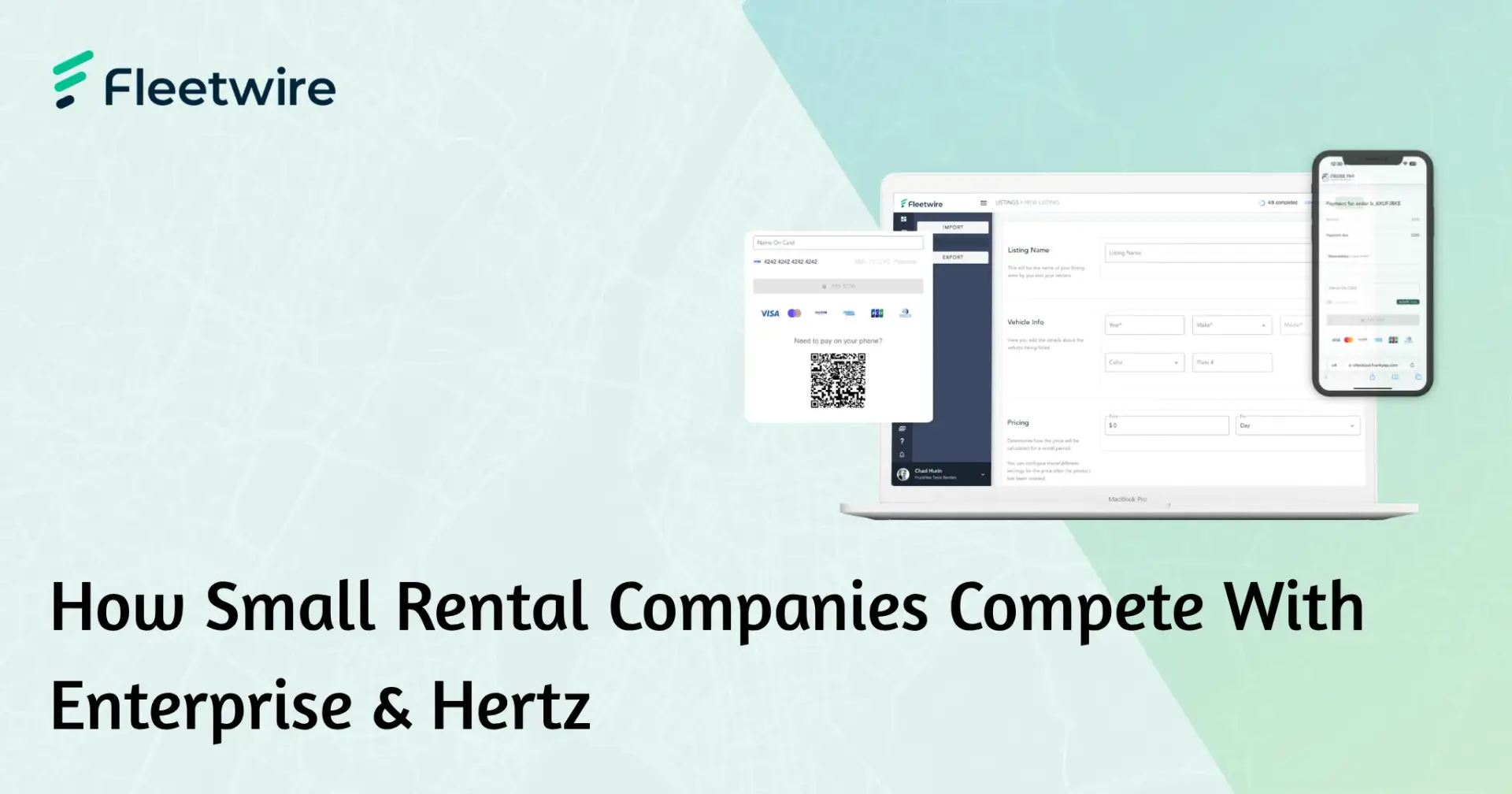
With Fleetwire, online booking, digital agreements, ID verification, insurance verification, and payments are bundled together. You get the professional renter experience people expect from national chains without the enterprise price tag or bloated setup.
What about when they really do just want the cheapest price?
Some renters are purely price-shopping. No amount of local service or better booking flow changes that.
That is fine.
You are not trying to win every renter. You are trying to stop losing the renters who would rather book local if given a clear and easy reason to do it.
Trying to win a pure price war against national fleet-buying discounts is usually a losing game.
Competing on trust, flexibility, visibility, and ease of booking is a game you can win.
The renter comparing on price alone may never become loyal. The renter who chooses you because you were easy to book, looked legitimate, and treated them like a person is the renter who comes back next time.
The bottom line
You are not going to out-advertise Enterprise, and you do not need to.
You can remove the small friction points that push renters toward the name they already recognize.
Make yourself bookable in two taps. Look professional at the moment it matters. Make sure Google shows your business to the person searching nearby.
That is not a corporate budget. It is a focused setup process.
Compete on your terms, not theirs
Fleetwire gives small and family-owned rental businesses the same booking, agreement, verification, and payment experience national chains offer, without the enterprise price tag or corporate red tape.
Start free with FleetwireFAQ
Can a small rental company really compete with Enterprise or Hertz online?
Yes. For local searches especially, a well-optimized Google Business Profile and easy online booking flow can help a small operator show up and convert renters who are already nearby.
Do I need expensive software to look professional?
No. What matters most is online booking, digital agreements, ID verification, insurance verification, and modern payments. Tools built for small fleets can start well under $30 per month.
What's the single highest-impact thing I can do this week?
Claim and completely fill out your Google Business Profile. It is free, takes under an hour for the basics, and can be a deciding factor in “car rental near me” searches.
Should I try to match national chains on price?
Generally no. Their fleet-buying discounts make a pure price war difficult. You will usually win better customers by competing on trust, flexibility, visibility, and ease of booking.