Ask hosts why they stay on Turo and insurance comes up within a minute. On a Turo trip, Turo’s protection plan sits behind every booking. On a booking you take yourself, it doesn’t, and many hosts don’t know what replaces it until a renter crashes one of their cars.
Here’s what Turo’s plan actually covers, why none of it follows you off the platform, and the coverage setup independent hosts use instead.
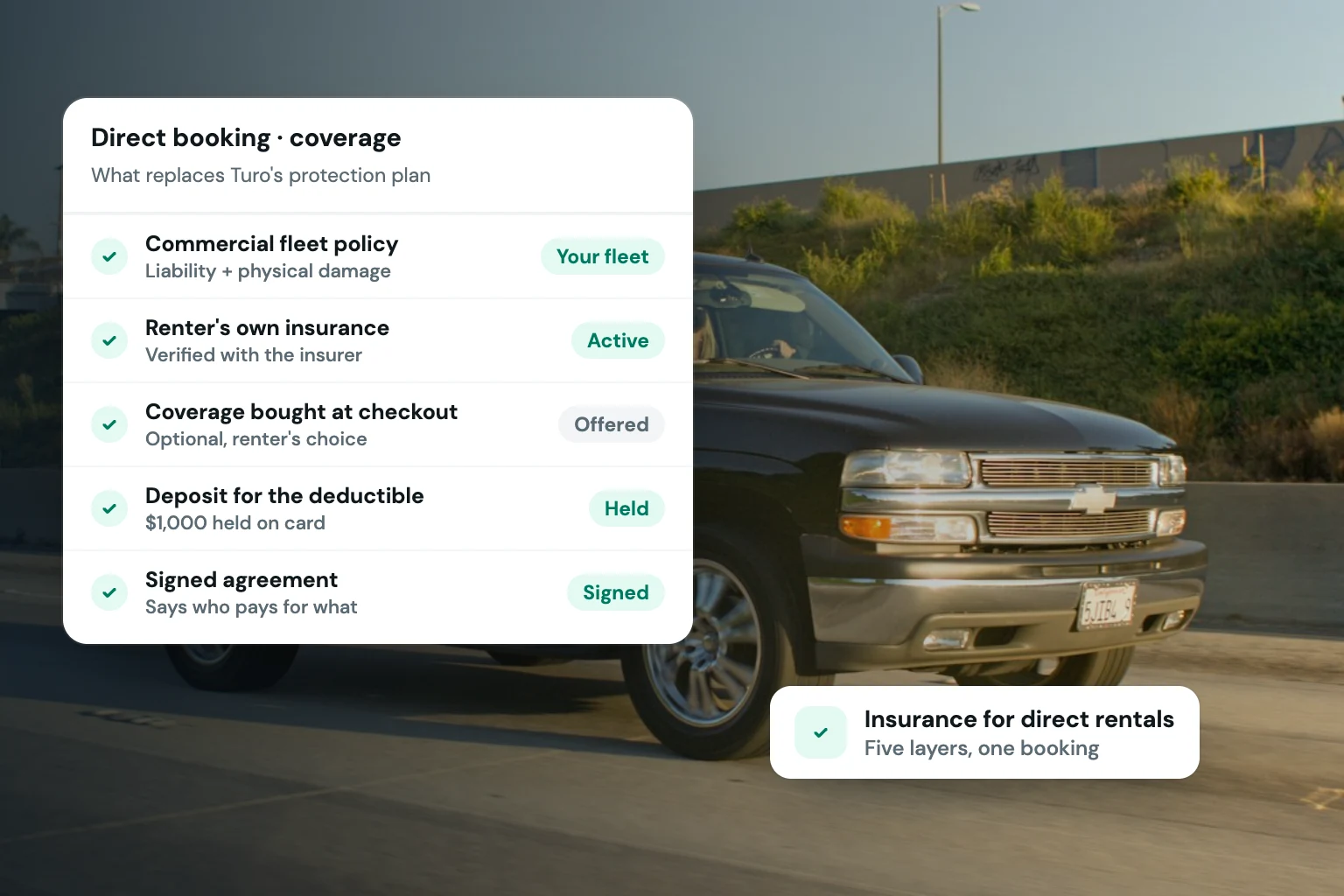
The short version. Insurance on direct rentals comes in layers: a commercial policy on your fleet, verified coverage from the renter, a deposit for the deductible, and a signed agreement that says who pays for what. Rules and prices vary a lot by state and vehicle. Use this guide to know what to ask, then get real quotes from a broker who writes rental fleets. Fleetwire doesn’t sell insurance, and this isn’t insurance or legal advice.
What Turo’s protection plan covers, and when it stops
Since January 2026, US hosts pick one of three earnings plans. You keep 70%, 80% or 90% of the trip price, and you’re responsible for the first $250, $1,500 or $2,750 of damage per claim. Every plan includes up to $750,000 in third-party liability insurance, under a policy issued to Turo by Travelers Excess & Surplus Lines, with higher or lower limits in some states and at some airports. Physical damage is reimbursed up to the car’s actual cash value. Small exterior wear, interior wear and lost hosting income aren’t covered.
All of it is attached to the trip, not the car. It applies because the trip was booked on Turo. Rent the same car to the same person through your own website and none of it applies. That’s the gap you have to fill.
Your personal auto policy almost certainly won’t cover it
Personal auto policies are written for you driving your own car. Most exclude using the car to carry people or property for a fee, and renting it out is the plainest example. Some states let peer-to-peer platforms provide coverage during a shared trip, which is why Turo trips work on a personal policy. A rental you run yourself isn’t a platform trip. If your cars are on a personal policy today, call your agent before you take your first direct booking.
The coverage layers that replace it
| Risk | On a Turo trip | On a direct booking |
|---|---|---|
| Injury or damage to other people | Up to $750,000 third-party liability, under Turo’s policy | Your commercial policy, the renter’s own auto policy, or coverage the renter buys at checkout |
| Damage to your car | Reimbursed up to the car’s actual cash value, minus your plan’s $250 / $1,500 / $2,750 | Physical damage on your commercial policy, the renter’s collision coverage, and your deposit for the deductible |
| Theft | Covered as physical damage, subject to Turo’s rules | Comprehensive on your policy, plus ID checks and GPS that make recovery likely |
| Tolls, tickets, cleaning, small dings | Billed back through Turo’s reimbursement process | Your rental agreement and a deposit held on the renter’s card |
| Income lost while the car is in the shop | Not included in the US plans | A loss-of-use clause in your agreement, where your state allows it |
1. A commercial rental policy on your fleet
This is the foundation. A commercial auto policy written for rental use covers liability and, if you buy it, physical damage to your cars while renters drive them. Expect a few conditions:
- You’ll need a business entity. Most programs write policies to an LLC or corporation, not to you personally. That’s worth doing anyway.
- Vehicle limits. Programs for small fleets often cap vehicle age and the physical damage limit per car. Exotics and high-value EVs may need a specialty policy.
- Rideshare and delivery are excluded. Nearly every rental fleet policy excludes Uber, Lyft and delivery driving, and on some policies that use voids coverage for the whole rental. If you rent to gig drivers, you need a policy written for that.
- Some states are harder. Programs for newer operators often skip several states entirely; established operators with loss history get more options.
Many fleet policies cover your cars on Turo and direct alike, which is what you want if you run both. Ask, and get it in writing.
2. The renter’s own insurance, verified
Many hosts make the renter’s personal auto policy primary: the renter’s insurer pays first, and your policy picks up what’s left. That only works if the policy is real, active, and extends to the car they’re renting. A photo of an insurance card proves none of that. We wrote about why a card isn’t verification; the short version is to check the policy with the insurer before pickup.
Two cautions. Credit card rental coverage is usually secondary, covers collision but not liability, and excludes exotics, trucks and long rentals. And a renter’s personal policy may carry only state-minimum liability, which won’t go far in a serious accident. Treat the renter’s coverage as a layer, not the whole plan.
3. Coverage the renter buys at checkout
Some hosts offer renters a policy at booking, for renters without their own insurance or who don’t want to risk it. Read the product carefully. Some cover liability and damage to your car from the first dollar. Others are supplemental liability: excess over the state minimum or over the renter’s own policy, which can leave your commercial policy paying first. Before offering anything, ask who the carrier is, whether it’s admitted in your state, and who handles claims. Then offer it as a choice, with “I have my own insurance” as the alternative, rather than forcing the purchase.
4. A deposit for the deductible
Whatever coverage pays, someone owes the deductible, plus the small stuff insurance never touches: a curb-rashed wheel, a smoked-in interior, a missing key fob. A security deposit held on the renter’s card covers that gap. Size it to your deductible or a typical small claim, and release it promptly when the car comes back clean.
5. An agreement that says who pays
Insurance decides which policy pays. Your rental agreement decides what the renter owes: the deductible, loss of use, tolls, cleaning, and what happens if an unlisted driver crashes. Our car rental agreement checklist covers what that section needs to decide: the renter’s policy as primary, or yours.
What it costs compared to Turo
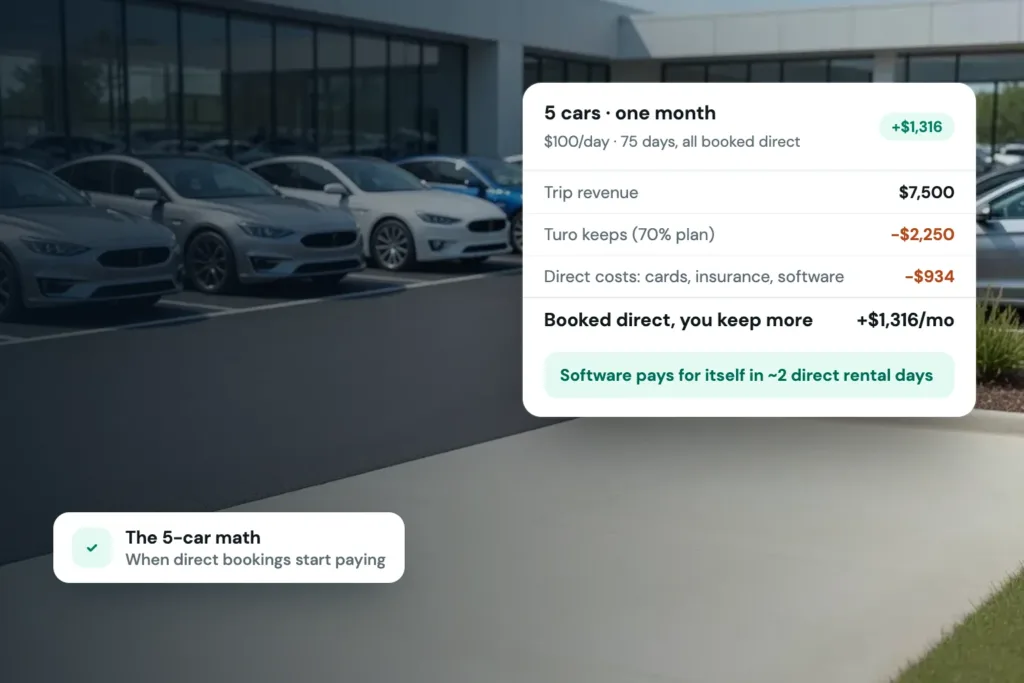
On Turo, insurance is built into the 10% to 30% of the trip price Turo keeps. On direct bookings you pay it separately, so it belongs in the math. Our 5-car math post uses $9 per rental day as an estimate for per-trip coverage, and even with that cost included, a direct booking keeps far more than a Turo trip on the 70% or 80% plan. Your real number depends on your state, vehicles and loss history. Get a quote before you assume anything, and plug it into the Turo fee calculator.
Questions to ask an insurance broker
- Does the policy cover cars rented directly to the public, or only on peer-to-peer platforms? Both?
- Is the carrier admitted in my state? What is its AM Best rating?
- Who handles claims, and how fast do they typically pay out?
- What is the physical damage limit per vehicle? Does it cover my most expensive car at full value?
- Does the policy follow the renter as primary, or does it sit over the renter’s own insurance?
- What exactly does the rideshare / delivery exclusion say? Does it void the whole rental or just that trip?
- Are there limits on renter age, vehicle age, or how far renters can take the car?
- Do I need to tell you about every rental, or is the fleet covered on a schedule?
Where Fleetwire fits
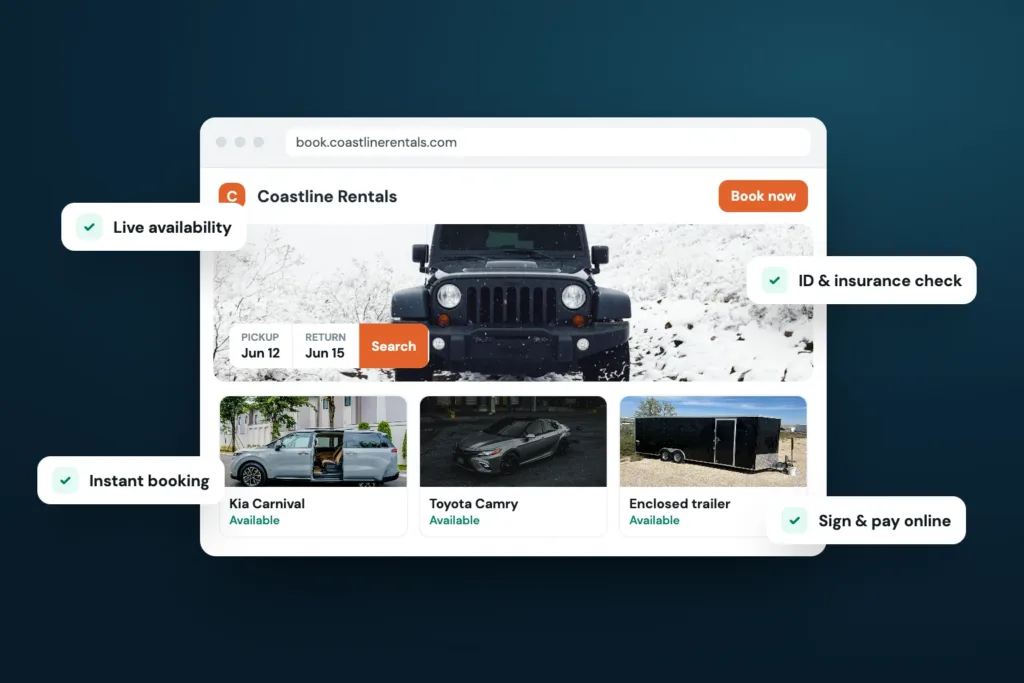
Fleetwire doesn’t sell insurance. It makes the coverage you choose enforceable on every booking. Renters can verify their insurance in checkout, checked with their insurer through Axle rather than from a photo of a card, with the policy, dates and coverage saved on the booking. ID verification confirms every listed driver is who they say they are, deposits hold the deductible on their card, and your agreement is e-signed before pickup. Turo trips stay on the same calendar, so you can grow the direct side one booking at a time.