Part of our guide: How to start a car rental business (without quitting Turo)
A recall letter goes to the address on the title. If you run a rental fleet, that letter can sit in a stack of mail while the car goes out on three more trips. Then a renter runs the VIN, or Turo blocks the listing, and you find out last.
This guide covers what an open recall actually means, which rules apply to independent hosts (the federal rule, Turo’s policy and state car-sharing laws), and how to check every car you own without doing it by hand.
TL;DR
- The federal rule against renting recalled cars applies to rental companies with 35 or more rental vehicles. Most independent hosts are under it.
- Turo applies its own rule to every host: an open recall blocks new bookings, and you have 72 hours after notice to take the car off.
- Many states with peer-to-peer car-sharing laws require the same: no listing until the repair is done, and notice to the platform if a renter has the car.
- Nothing checks the cars you rent on your own website. That part is on you.
- Our free recall check looks up any car in seconds, and Fleetwire recall alerts check your whole fleet every night.
What an open recall means
A safety recall is a manufacturer’s admission that a defect, or a failure to meet a federal safety standard, affects a group of vehicles. The manufacturer files it with NHTSA, mails owners, and pays dealers to fix it. “Open” means the fix hasn’t been done on your car yet.
Each recall has a campaign number, the affected component, the consequence (what can go wrong) and the remedy (what the dealer will do). Two flags matter more than the rest:
- Do not drive (also called “park it”). The manufacturer advises owners not to drive the car until it’s repaired.
- Park outside. The manufacturer advises parking the car outside and away from buildings, usually because of fire risk.
Those advisories come from the manufacturer. Whether a car goes out is still your decision, but those are the recalls to act on the same day.
What a “do not drive” recall means for a rental car
A do-not-drive recall is the manufacturer saying the defect is dangerous enough that the car shouldn’t move until it’s fixed. Only a small share of recalls carry it, and NHTSA’s data labels them so they’re easy to spot. For a host, it means the next trip is at stake, not just the next service visit. Check whether the car has a booking coming up, call a franchised dealer about parts, and ask whether the manufacturer covers towing for that campaign, since some do. Our free recall check sorts do-not-drive and park-outside recalls to the top.
The federal rule: the Safe Rental Car Act
After two sisters died in a rented car with an unrepaired recall, Congress passed the Raechel and Jacqueline Houck Safe Rental Car Act as part of the FAST Act. It took effect in 2016. Under it, a rental company that gets a recall notice may rent, sell or lease the car only after the defect is fixed. It has to ground the car within 24 hours of the notice (48 hours if the recall covers more than 5,000 of its cars). If the remedy isn’t available yet and the manufacturer lists an interim fix, the company can rent the car once that interim fix is done.
The rule applies to a “rental company”: one renting vehicles of 10,000 lb or less, on terms under four months, from a fleet of 35 or more rental vehicles on average during the year. Fewer than 35 cars and the federal rule doesn’t reach you.
It’s enforced. In 2023 NHTSA fined Zipcar $300,000 for renting cars with open recalls, its first action of that kind against a rental company. Zipcar said fewer than 50 cars were involved.
Exempt isn’t the same as safe. If an accident happens in a car with an open recall you knew about, the federal threshold won’t be the question anyone asks. Your insurer, the renter’s lawyer and the platform will ask whether you knew.
Turo’s rules for hosts
Turo applies a recall rule to every US host, whatever the fleet size. From its safety recall policy:
- Turo checks listed cars by VIN for as long as they’re on the platform, and a car with an open recall can’t be listed.
- After a recall notice, you must remove the car as soon as possible and no later than 72 hours later. Otherwise Turo may void your earnings plan on trips completed with that car.
- Turo blocks new bookings and cancels upcoming trips: penalty-free in California and Hawaii, and elsewhere seven days before the trip starts (or right away if it starts sooner).
- In states with car-sharing regulations, if a guest has the car when the notice arrives, you must tell Turo and the guest, and you can’t relist until the repair is made.
Once the repair shows up in NHTSA’s database, Turo lifts the restriction on its own. If it doesn’t, it asks for the dealer’s paperwork showing the date, the recall and the VIN.
State car-sharing laws
Many states that regulate peer-to-peer car sharing write recalls into the statute, and they follow a common pattern. Nevada’s (NRS 482C.340) is typical:
- Before a car is listed, the platform must verify it has no unrepaired safety recalls.
- An owner who has received a recall notice can’t list the car until it’s repaired.
- If the notice arrives while the car is listed, the owner must remove it as soon as practicable.
- If the notice arrives while a renter has it, the owner must notify the platform as soon as practicable.
Similar language appears in Maine, Mississippi and a long list of other states. The exact deadlines and definitions vary, so read your own state’s code or ask your attorney.
The gap: your direct bookings
Every rule above has something checking for you. The federal rule makes large rental companies check, Turo runs the VIN, and state laws make the platform verify. None of that touches a car you rent on your own website.
The same goes for timing. A recall that was published before you bought a car doesn’t send you a new letter. A used car you added last month can arrive with a recall that’s been open for a year.
How to check one car for free
Our recall check takes up to ten VINs, or a year, make and model, and lists every recall NHTSA has for that model. Recalls with a park-it or park-outside advisory sort to the top. It runs in your browser against NHTSA’s public data, with no signup, and the VINs you enter never reach our servers.
One limit to know: it checks the model, not your exact car. A model-level result tells you a recall exists for cars like yours. To confirm your VIN is affected and see whether it was already repaired, run it on nhtsa.gov/recalls.
How to keep checking a whole fleet
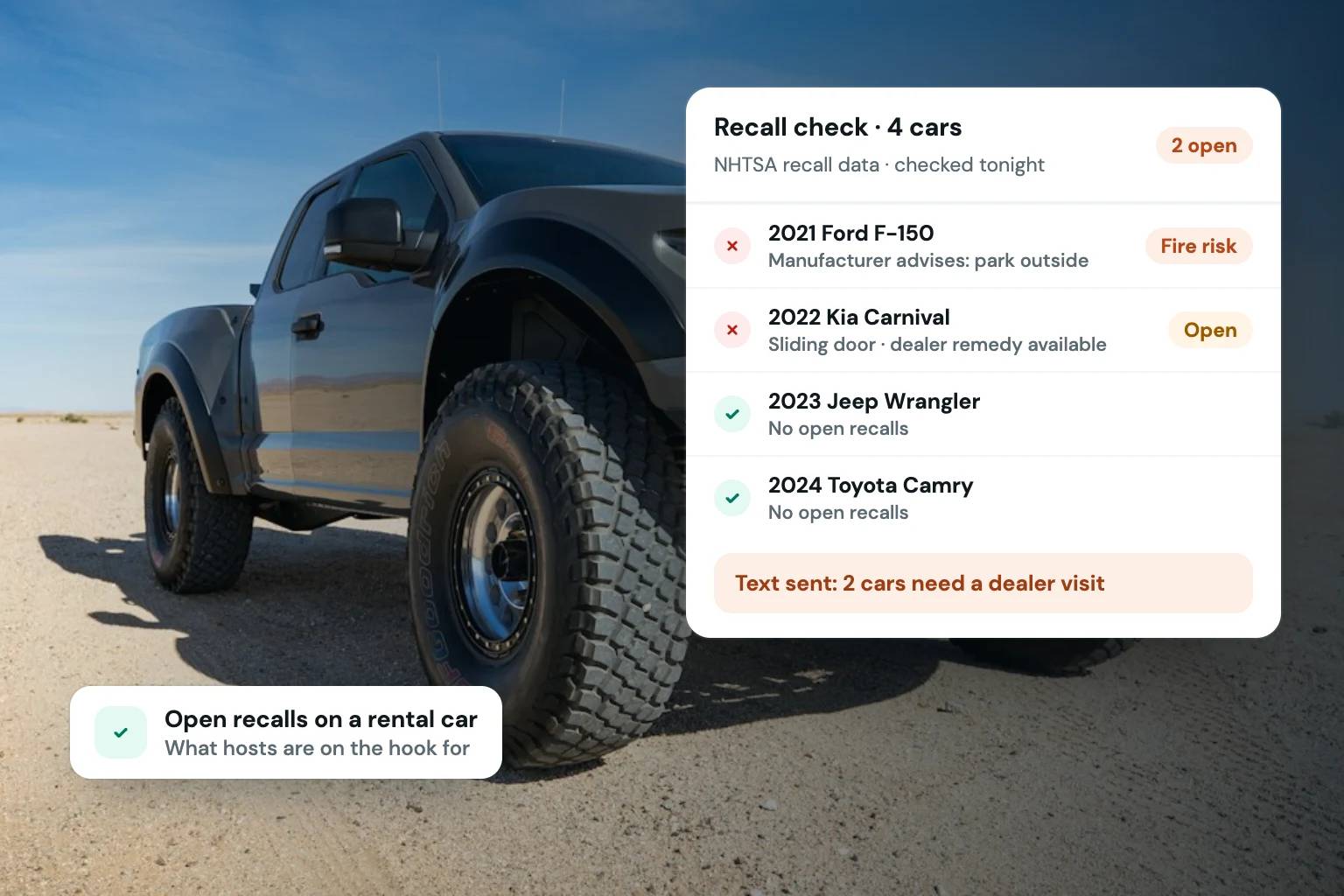
Checking once is easy. Doing it every week for every car is where it falls apart. Fleetwire recall alerts run the check every night for the year, make and model of every car, trailer, powersports vehicle and golf cart you list:
- When a new recall matches, you get one text naming the affected cars, plus a dashboard notification.
- Advisories come first. If the manufacturer says not to drive the car or to park it outside, the alert says so up front.
- The full recall lands on the car’s Maintenance tab: component, campaign number, consequence and the manufacturer’s remedy.
- Cars you add later are checked from their first night, against recalls that were already out.
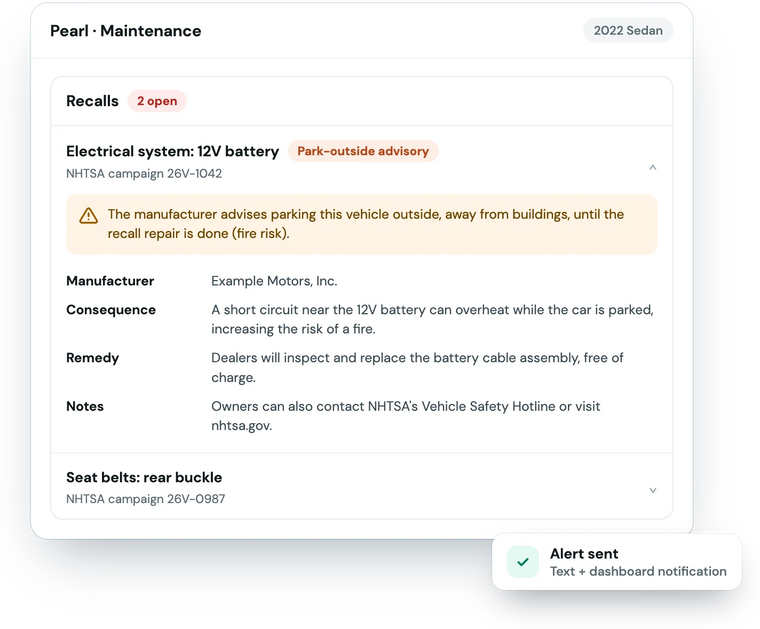
It’s included on every plan, and there’s nothing to connect. If a car has a year, make and model, it’s covered.
When a recall hits a car that’s already booked
A short checklist for the day the alert comes in:
- Read the manufacturer’s advisory first. Most recalls don’t come with one. When the manufacturer says not to drive the car, or to park it outside because of fire risk, that changes how fast everything below has to happen.
- Look up the VIN on nhtsa.gov. A model-level match means the recall covers cars like yours. The VIN lookup tells you whether yours is one of them and whether it has already been repaired.
- Call a dealer and ask about parts. Some remedies are ready the same week. Others wait months for parts, and the manufacturer may list an interim step in the meantime.
- Decide what happens to the next trip. Keep it, swap the renter into another car, or reschedule. It’s your call, and on Turo or in a state with a car-sharing law it may not be only yours.
- Tell the renter, in writing. If they’re mid-trip or booked soon, a short, plain message beats them finding the recall on their own. Turo and several states require you to notify the platform too.
- Block the car’s calendar until the repair. So no new direct booking lands on it while you wait for the dealer.
- Keep the dealer’s paperwork. The repair order shows the date, the campaign and the VIN. Turo asks for exactly that if a restriction doesn’t lift on its own.
FAQ
Does the Safe Rental Car Act apply to Turo hosts?
The federal rule is written for rental companies with fleets of 35 or more rental vehicles, on average, over the year. Most individual hosts are well under that. Turo’s own policy and state car-sharing laws still apply to you, and if you’re near 35 cars, ask your attorney how your fleet is counted.
How long do I have to fix a recall on Turo?
Turo asks you to remove the car no later than 72 hours after you’re notified. If you don’t, it can void the earnings plan on trips completed with the recalled car.
Does every recall mean the car can’t be driven?
No. Most recalls ask you to book a repair. A small share come with a manufacturer advisory not to drive the car, or to park it outside, and those are the ones to act on the same day.
Who pays for the repair?
The manufacturer. Recall remedies are done free at a franchised dealer for most cars, though very old vehicles can fall outside that.
Does a free recall lookup check my exact car?
Lookups by year, make and model, including ours, show recalls for the model. Only a VIN search on nhtsa.gov/recalls confirms whether your specific car is affected and whether it was already repaired.
Get recall alerts on your fleet
Start a 14-day free trial, add your cars, and the first check runs that night. No credit card needed.
Sources
- 49 U.S.C. § 30102, definitions of “covered rental vehicle” and “rental company”
- 49 U.S.C. § 30120(i), rental companies and open recalls
- Turo: Safety recalls, US hosts
- Turo: Resolve a safety recall
- Nevada NRS 482C.340, peer-to-peer car sharing and safety recalls
- Maine 24-A § 7404-A, responsibilities of peer-to-peer car sharing programs
- Mississippi 19 Miss. Code R. 9-2.17, automobile safety recalls
- KSAT / AP: Zipcar fined after allowing customers to rent vehicles with open recalls (2023)
- NHTSA recall lookup by VIN
This article is general information, not legal advice. Fleetwire isn’t affiliated with NHTSA or Turo. Recall data comes from NHTSA, and advisories come from the manufacturer.