Part of our guide: How to start a car rental business (without quitting Turo)
Turo income is taxable whether or not Turo sends you a form. What changes from host to host is who reports it, who collects the sales tax, and what you need to have ready in January. Here’s how each works for Turo trips, and what changes when you take bookings yourself.
General information, not tax advice. Tax rules depend on where you live, how your cars are owned and the rest of your return. Use this to get organized, then take it to a licensed tax professional.
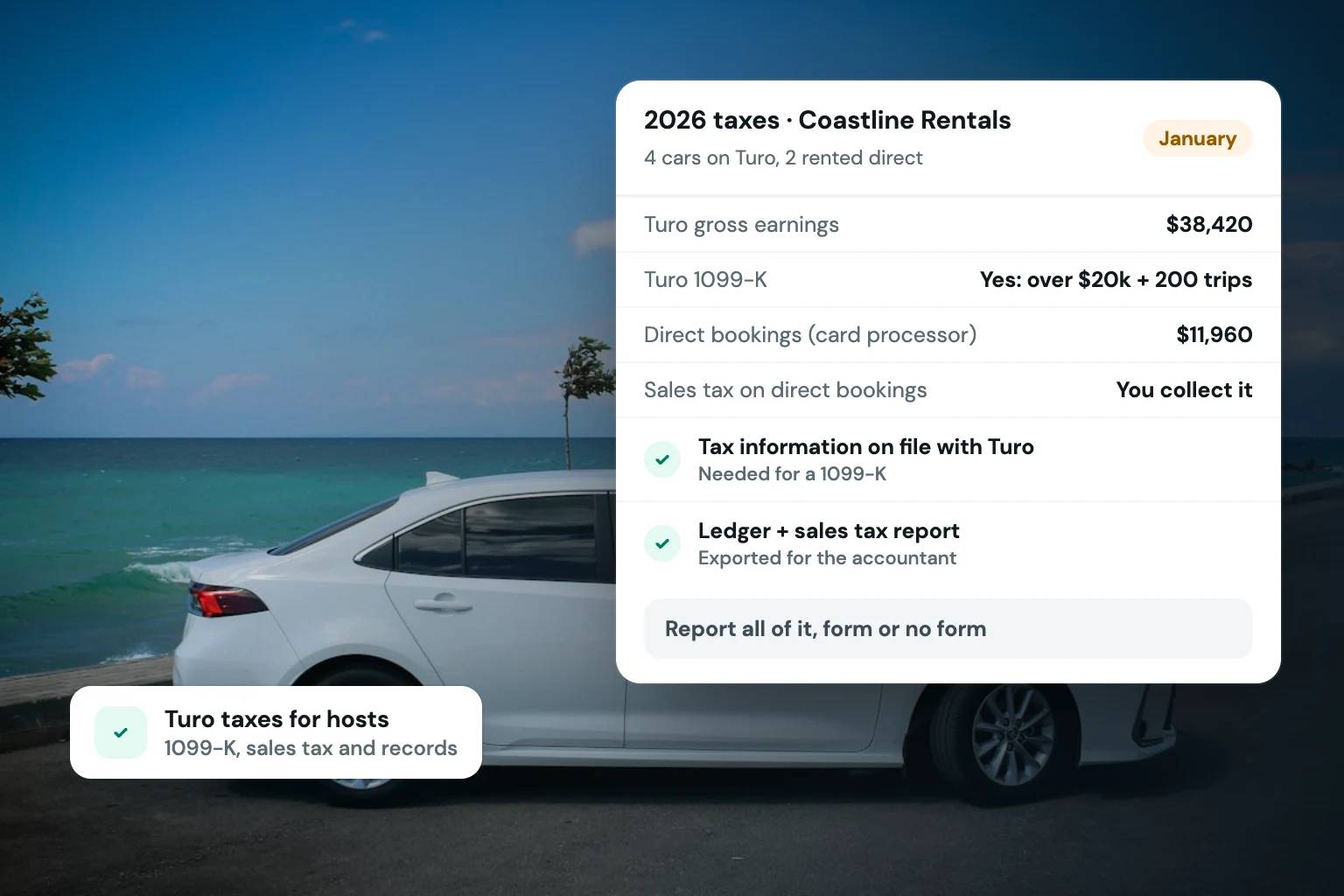
The short version. Turo sends a 1099-K only if you earned $20,000 across 200 transactions (or your state’s lower threshold), but you report all of it either way. Turo collects sales and rental taxes from guests in every state except Delaware, and charges Texas hosts sales tax on their earnings. On direct bookings, your card processor reports your payments, and collecting the tax is your job.
Will Turo send you a 1099-K?
A 1099-K is the form payment platforms send to you and the IRS to report what you were paid. Turo sends one if all of these are true (Turo’s 1099-K page):
- You’re a US person.
- Your tax information was on file by Turo’s deadline. For the 2025 tax year, that was January 12, 2026.
- You had $20,000 in gross earnings with 200 transactions, or you live in a state with a lower threshold.
That threshold is new again. It had been heading down to $600, and the One Big Beautiful Bill moved it back to $20,000 and 200 transactions starting with 2025, as Turo’s host tax resources page explains. Most small hosts won’t get a form, but every US host still has to submit tax information to Turo.
If you qualify, Turo emails the 1099-K by January 31 and posts it in the Tax information section of the Earnings tab. Turo doesn’t mail one unless you ask for a paper copy before December 31. Turo hasn’t published its dates for the 2026 tax year yet, so check that page in early January.
One thing surprises hosts every year: the 1099-K reports gross earnings, and Turo’s own FAQ notes that won’t match your earnings chart. The Tax information page breaks the difference down. Give that breakdown to whoever does your return.
Sales and rental tax on Turo trips
Turo collects and pays sales tax under peer-to-peer, marketplace facilitator and economic nexus laws. According to its guest and host sales tax pages:
- Guests pay it at checkout in every US state except Delaware. That can include rental car tax, peer-to-peer car sharing tax and tourism tax, and it can apply to tolls, fees and trip changes too.
- Texas: Turo charges sales tax on host earnings, including extra distance, extra usage and late return fees, so Texas hosts are paid net of it.
- Hawaii: Turo collects and remits General Excise Tax and the Rental Motor Vehicle Surcharge Tax, but Turo notes that some GET obligations remain with the host.
Turo also says hosts are responsible for knowing their own tax obligations, so ask your tax professional whether anything local applies on top.
Income tax: what you report
The IRS is plain about it: “Whether or not you receive a Form 1099-K, you must still report any income on your tax return.” Turo trips are income from providing a service, so they belong on your return in the year you earn them.
The other side of the ledger is expenses. Running cars for rent costs money, and those costs are why good records matter as much as the 1099-K. Turo publishes a free tax guide for hosts written by its tax consultants, and the IRS has a gig economy tax center. Read both before your appointment, not instead of it.
Turo trips vs direct bookings
If you rent some cars outside Turo, the tax picture splits in two:
| Turo trips | Direct bookings | |
|---|---|---|
| Who reports your income to the IRS | Turo, on a 1099-K, if you pass $20,000 and 200 transactions (or your state’s lower line) | Your card processor, such as Stripe or Square. The IRS says a processor sends a 1099-K for card payments however few there are |
| Who collects sales or rental tax from the renter | Turo, in every state except Delaware | You, at the rates your state, county and city set |
| Who pays it to the state | Turo, as a marketplace facilitator | You |
| Your income tax | Yours to report, 1099-K or not | Yours to report |
The big one is sales tax. On Turo, the platform charges the guest and pays the state. On your own booking site, nobody does that for you. Find out which rental and sales taxes apply where you operate, add them to every booking, and keep a record of what you collected and paid.
In Fleetwire, you set your rates once under Settings → Taxes and they’re added to every booking and invoice as their own lines. At year end, the Orders export includes a transactions ledger (CSV, QuickBooks or Xero format) and a sales tax report, cash or accrual, so your accountant gets the numbers in the shape they want. Turo’s earnings stay in Turo’s report.
A January checklist for hosts
- Check your tax information is current with Turo. Without it, Turo won’t send a 1099-K. For the 2025 tax year the deadline was January 12, 2026.
- Download your Tax information page. It breaks down your gross earnings, which is the figure a 1099-K reports, and why it differs from your earnings chart.
- Pull every other income source. Getaround, direct bookings and cash rentals don’t appear on Turo’s form.
- Gather your expense records. Loan or lease payments, insurance, maintenance, cleaning, parking, tolls you paid, software. Receipts beat bank statements.
- Write down your mileage. Ask your tax professional how they want business and personal miles split, before the year is over if you can.
- Book the tax professional early. January and February fill up, and a car-sharing return has more moving parts than a W-2.
FAQ
Do I have to pay taxes on Turo income?
Yes. Turo says you’re responsible for declaring all taxable income, and the IRS says you must report income from goods or services whether or not you get a 1099-K. What you owe depends on your expenses and the rest of your return, so that part is for a tax professional.
Will Turo send me a 1099-K?
Only if you’re a US person, your tax information is on file by Turo’s deadline, and you had $20,000 in gross earnings across 200 transactions, or you live in a state with a lower threshold. Turo emails it by January 31 and posts it on your Tax information page. Turo doesn’t mail paper copies unless you ask by December 31. Turo’s 1099-K page has the details.
What is the $600 tax rule?
The 1099-K threshold for payment apps and marketplaces dropped to $600 under a 2021 law, but the One Big Beautiful Bill moved it back to $20,000 and 200 transactions starting with 2025. That changes who gets a form, not what counts as income.
Does Turo collect sales tax?
From guests, in every US state except Delaware, including rental car, peer-to-peer car sharing and tourism taxes where they apply. In Texas Turo also charges sales tax on host earnings, so Texas hosts are paid net of it. In Hawaii Turo collects General Excise Tax and the Rental Motor Vehicle Surcharge Tax, but Turo notes some GET obligations stay with the host. See Turo’s host and guest sales tax pages.
Do I charge sales tax on direct bookings?
Often, yes. Rental and sales taxes are set by your state, county and city, and on a direct booking nobody collects them for you. Ask your tax professional or your state revenue department which apply to your rentals, then add them to every booking so they show on the invoice.
Can I deduct my car?
The costs of a car used to earn rental income can be deductible, and so can the costs of running the business. Which method applies, and how much, depends on how the car is used and owned, so that’s a question for your tax professional. Turo’s free tax guide for hosts walks through the common cases.
Sources
- Turo: Tax resources for US-based Turo hosts (read November 19, 2026)
- Turo: Receiving a 1099-K (read November 19, 2026)
- Turo: Sales tax | Hosts (read November 19, 2026)
- Turo: Sales tax | US guests (read November 19, 2026)
- Turo: Tax guide for US Turo hosts (PDF)
- IRS: Understanding your Form 1099-K (read November 19, 2026)
- IRS: Gig economy tax center
This article is general information, not tax, legal or accounting advice. Tax rules and Turo’s policies change; everything above is as published on the dates listed. Talk to a licensed tax professional about your situation. Fleetwire isn’t affiliated with Turo or the IRS.