Part of our guide: How to start a car rental business (without quitting Turo)
Most car rental marketing advice is written for agencies selling to rental chains. If you run three cars, or thirty, you don’t need a brand campaign. You need people in your area to find you, trust you enough to book, and come back. Here are the seven channels that do that, in the order that makes the most of a small budget and a busy week.
The short version. Start with what’s free and compounds: your Google Business Profile, a booking site on your own domain, and your past renters. Add local partners and social media next. Use marketplaces to fill gaps, and save paid ads until you can see which bookings each channel actually brings in.
The channels at a glance
| Channel | Cost | Time to first bookings | Best for |
|---|---|---|---|
| 1. Google Business Profile and reviews | Free | Weeks | People searching “car rental near me” in your area |
| 2. Your own booking site | Low monthly | Days to set up | Turning every other channel into bookings you keep |
| 3. Repeat renters | Free | Immediate | Your cheapest booking: someone who already trusts you |
| 4. Local partners | Your time, maybe a referral fee | One to three months | Steady demand from people who need a car now |
| 5. Social media | Free, but time | Months | Trust and recognition, especially for specialty cars |
| 6. Marketplaces | A share of every trip | Days | Filling gaps while your direct demand grows |
| 7. Paid ads | Whatever you set | Days | Scaling what already works, once you can measure it |
Where Fleetwire fits: channels 2, 3 and 6. That means your booking site, messages and coupons for repeat renters, and Turo calendar sync. The rest is up to you, and this guide covers it.
The order matters because each channel feeds the next. Ads and social posts need somewhere to send people. Reviews make every other channel convert better. And a repeat renter costs you nothing to win a second time.
1. Google Business Profile and reviews
When someone searches “car rental near me” or “rent a Jeep in [your town]”, Google shows a map with three businesses before any website. That map pulls from Google Business Profiles. A complete profile, real photos of your actual cars, the right categories and a steady stream of recent reviews are the closest thing to free customers in this business.
Ask every happy renter for a review, the day they return the car, while the trip is fresh. Reply to every review, good or bad, because the next renter reads your replies too. We wrote a full walkthrough in Local SEO for car rental companies, including categories, photos and a 30-day plan.
2. A booking site on your own domain
Every other channel ends in the same question: where does the renter book? If the answer is “text me” or a marketplace listing, you lose people who want to book at 11pm, and you hand the relationship to someone else. A booking site on your own domain lets renters see real availability, pay, sign and upload their license in one visit, and it’s what your Google profile, partners and social posts link to.
What a renter needs to see before they trust a small operator: real photos, clear prices with every fee shown, live availability, and a checkout that looks like a business, not a form. The rental website features that matter goes deeper, and how to get direct bookings covers removing friction at checkout.
In Fleetwire, that’s the branded storefront, on your own domain if you want, with ID verification, deposits and e-signed agreements built into checkout. If you already have a WordPress site, the Fleetwire plugin puts your listings and booking on it.
3. Repeat renters
The renter who already drove your car, returned it on time and left a good review is your cheapest next booking. Most hosts never ask them back. Simple ways to do it:
- Keep their contact details in your own system, not only inside a marketplace inbox.
- Send a thank-you after the trip with a link to your site, and a review request.
- Give them a reason to return: a returning-renter code, first pick on new cars, or a heads-up before holiday weekends sell out.
Fleetwire’s auto-messaging sends booking emails and texts without you typing them, and coupon codes can be limited to specific listings, so a returning-renter offer doesn’t have to apply to your newest car.
Not Turo guests. Turo’s gray market policy prohibits finding a guest on Turo and completing the deal outside it, and breaking it can cost fees or your account. Repeat-renter marketing is for renters who booked with you directly.
4. Local partners
Some businesses meet people who need a car every week. A short visit, a stack of cards and a simple referral arrangement can turn them into a steady source of bookings:
- Auto body and repair shops. Their customers need a car for days or weeks while theirs is in the shop.
- Hotels, short-term rentals and vacation property managers. Their guests arrive without a car and ask the front desk or host what to do.
- Car dealerships without a loaner fleet. Service customers need something to drive, and the dealer may not want to run rentals.
- Wedding, event and film planners. They book specialty and exotic cars, often more than once a year.
- Local employers, insurance agents and relocation companies. New hires, claims and moves all create short stretches without a car.
Make it easy for them: one link or QR code that goes straight to your booking page, and a coupon code with their name in it so you can see who sent whom. If you pay a referral fee, agree on it in writing.
5. Social media
Social media rarely produces a booking the day you post, but it’s where renters check that you’re real, and where specialty cars sell themselves. Pick one or two platforms your renters use, often Instagram and Facebook, and post what only you can show: the cars, the handovers, the places renters took them (with permission), and the dates you have open. A short video walk-around of a car will do more than a polished graphic.
Put your booking link in your profile, and link to the specific car when you post about it. Local Facebook groups are worth more than broad hashtags: answer questions, don’t spam.
6. Marketplaces, on purpose
Turo, Getaround and similar marketplaces bring renters you could never reach alone, and they’re a reasonable way to fill a calendar. They also keep a share of every trip, set the rules, and own the relationship with the guest. Treat them as one channel, not the business. Our free Turo fee calculator shows what each channel really pays on your numbers.
If you list the same cars on a marketplace and your own site, keep the calendars in sync so you never double-book. Fleetwire’s marketplace calendar sync blocks your dates when a Turo trip is booked.
7. Paid ads, last
Google Ads and Meta ads work for rentals, but they reward businesses that already convert. Before spending, make sure your site loads fast on a phone, your reviews are visible, and you can tell which bookings came from ads. Then:
- Target your area, not the country. Most rental searches are local.
- Bid on intent, such as “car rental [your city]” or “[car model] rental near me”, not broad terms like “cars”.
- Do the math on your own numbers. Divide what you spent by the bookings it produced, and compare that to the profit on an average booking. If one booking costs more than it earns, fix the site or the targeting before spending more.
Know where every booking came from
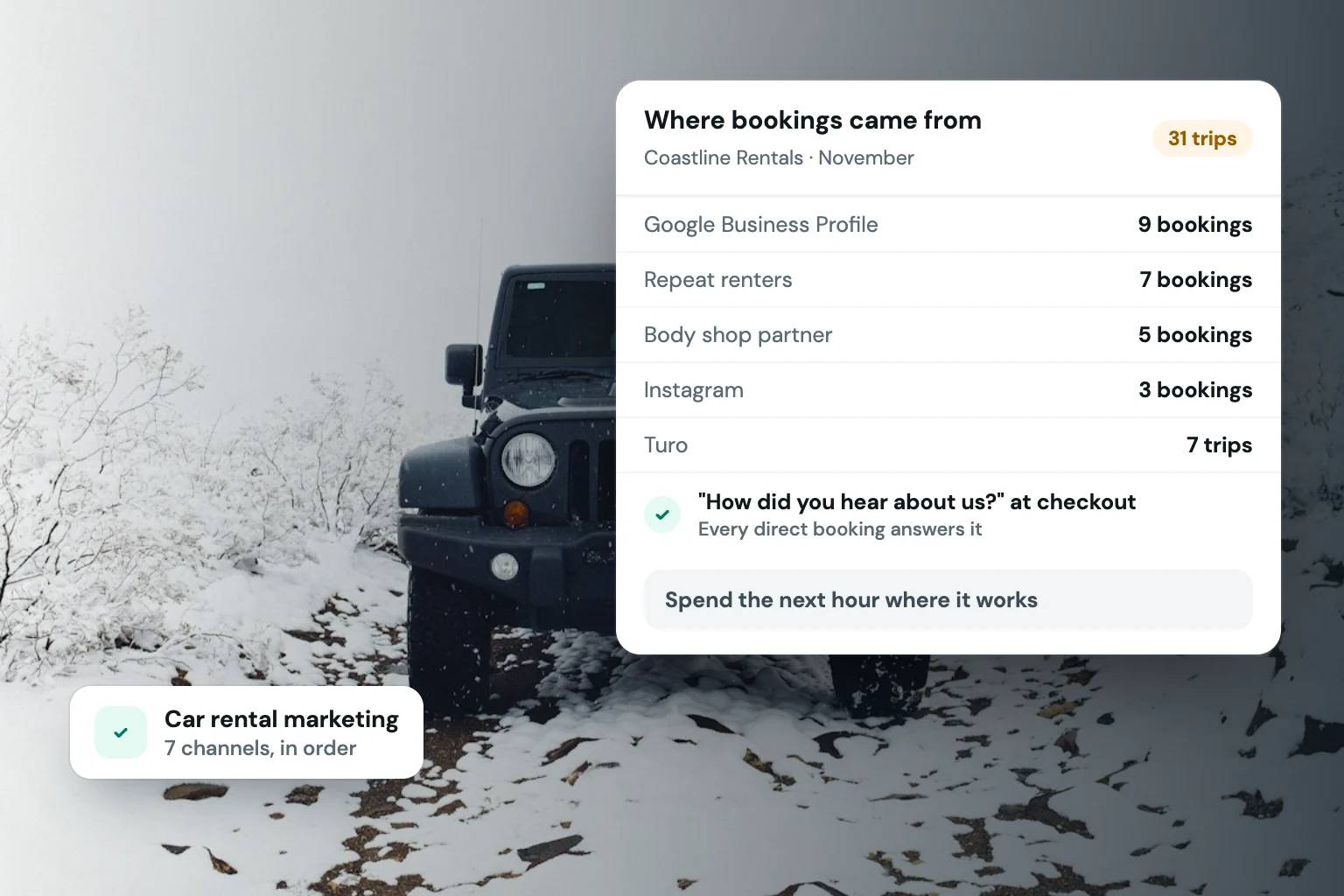
None of this works if you can’t tell which channel is paying off. The simplest tracking is to ask: add a “How did you hear about us?” question to checkout, and give each partner their own coupon code. In Fleetwire, custom checkout fields let you add that question to every booking. After a few months, the answers tell you where to spend the next hour and the next dollar.
FAQ
How do I promote my car rental business?
Start with the free channels that compound: a complete Google Business Profile with reviews, a booking site on your own domain, and a reason for past renters to come back. Then add local partners and social media. Paid ads come last, once you can see which bookings each channel produced. Our local SEO guide covers the Google side step by step.
How do I get customers for my car rental business?
The quickest first customers are usually people who already know you: past renters, friends of past renters, and local businesses whose customers need a car, such as body shops and hotels. Strangers find you through Google Maps and search, so the Google Business Profile matters early, and a marketplace like Turo can fill the calendar while that builds.
How profitable is a car rental business?
It depends on your costs per car, how often each car is booked and how much of every trip a marketplace keeps. Run your own numbers in our free rental car profit calculator, and read the 5-car math for when direct bookings start to change the picture.
What companies will pay you to advertise on your car?
Wrap programs such as Carvertise and Wrapify pay drivers to carry ads, but they are built around how much and where the owner drives, so check their terms before assuming a rental car qualifies. For a rental fleet, the more useful advertising on the car is usually your own: a tasteful decal or license plate frame with your website, so every renter who parks it is promoting you.
Should I advertise my Turo cars to book direct?
Not to Turo guests. Turo’s gray market policy prohibits finding a guest on Turo and completing the deal outside it, with fees and possible removal from the platform. Build your direct audience separately, through Google, partners, social media and your own site.
Is Google Ads worth it for a small car rental business?
It can be, once the basics are working. Ads send people to your site, so a slow or untrustworthy booking page wastes the money. Start small, with a daily budget you can afford to lose while you learn, target your city, and compare the cost of each booking to what that booking earns you.