Part of our guide: How to start a car rental business (without quitting Turo)
Most car rental business plan templates are written for a company opening a rental counter with 50 cars and a loan officer to impress. If you’re running a few cars on Turo, or about to buy your first, you need something shorter that still holds up when a lender asks. This page has both: a one-page plan for every host, and the full outline for when you need financing.
The short version. Start with the one-page lean plan below. It takes an afternoon and answers the questions that matter: who rents from you, how they find you, and what each car costs and earns. If you’re applying for a loan, expand it into the eight-section outline the SBA recommends, with monthly projections for the first year. Either way, the financial section is just three numbers per car: daily rate, booked days, and monthly costs.
Which plan do you need?
The U.S. Small Business Administration describes two formats. A traditional plan is detailed and can run to dozens of pages; lenders and investors commonly ask for it. A lean plan fits on one page and can be written in about an hour. For a host with one to ten cars and no loan application, the lean plan is enough. If you’re financing cars or asking a bank for a line of credit, write the traditional plan.
The one-page lean plan
The SBA’s lean format has nine boxes. Here’s what goes in each for a rental fleet:
| Box | What to write for a rental fleet |
|---|---|
| Customer segments | Who rents from you? Tourists at the airport, locals whose car is in the shop, gig drivers, wedding parties. |
| Value proposition | Why you over the rental counter: the car type, delivery, price, flexibility, or the person handing over the keys. |
| Channels | Where bookings come from: Turo or other marketplaces, your own booking site, Google, partners, repeat renters. |
| Customer relationships | How renters deal with you: self check-in or in person, text or email, what happens after the trip. |
| Revenue streams | Daily rates, delivery fees, extras (car seats, extra miles, prepaid fuel), and long-term or monthly rentals. |
| Key resources | The cars, insurance, parking, cash for repairs, your time, software. |
| Key activities | Cleaning, handovers, maintenance, pricing, answering renters, chasing damage and tolls. |
| Key partnerships | Insurer, mechanic, detailer, body shop, parking, local businesses that send you renters. |
| Cost structure | Loan or purchase, insurance, depreciation, maintenance, cleaning, parking, platform fees, card fees, software. |
Fill it in honestly. If the “Channels” box only says “Turo”, that’s fine for year one, but it’s also the biggest risk in your plan: one platform sets your fees and can delist a car. The 5-car math shows when that starts to cost real money.
The full business plan, section by section
These are the SBA’s traditional sections, with prompts written for car rental. You don’t have to use every section; the SBA says to use the ones that make sense for your business.
1. Executive summary
Write it last, in half a page.
- What you rent, where, and to whom.
- How many cars today, and how many in 12 and 36 months.
- If you’re asking for money: how much, what for, and how it gets paid back.
2. Company description
What problem you solve for renters, and why you’re the one to solve it.
- Your market in one sentence: “SUVs for families flying into Orlando,” not “car rentals.”
- What you do better than the counter or other hosts: delivery, vehicle type, price, service.
- Where you operate from, and where you deliver.
3. Market analysis
Proof that people near you rent cars like yours.
- Who books in your area and why: airport traffic, tourism, a hospital or base, local repair shops.
- What’s already listed nearby on Turo and at the counters, and at what prices.
- Seasonality: your busy and slow months.
4. Organization and management
Who runs it and how it’s set up.
- Legal structure (LLC, sole proprietor, and so on). Ask an accountant or attorney which fits, and how it affects insurance.
- Who handles cleaning, handovers, maintenance and renter messages, and who covers when you can’t.
- Any co-hosts or contractors, and how they’re paid.
5. Service line: your fleet and terms
What a renter actually gets.
- Each car: make, model, year, mileage, how you own it (cash, loan, lease) and its target daily rate.
- Your rules: minimum age, deposit, mileage limits, delivery area, cancellation. Put the wording itself in your rental agreement.
- How you’ll replace cars as they age. Turo’s limits (12 years, 130,000 miles) matter if you list there; see best cars for Turo.
6. Marketing and sales
How renters find you and book.
- Your channel mix this year and the target mix in two years (for example, all Turo now, a third direct later).
- The first channels you’ll work on. Car rental marketing for independent hosts ranks them.
- How a booking happens: where renters pay, sign, verify ID and get the keys.
7. Funding request
Only if you’re asking a lender or investor.
- How much, for what (cars, insurance down payments, parking, a cash cushion for repairs).
- Debt or equity, and the terms you want.
- How the money is paid back, tied to the projections below.
8. Financial projections
The section a lender reads first. Monthly for year one, yearly for years two to five.
- Revenue per car: daily rate × booked days a month, minus platform fees.
- Costs per car: loan or depreciation, insurance, maintenance, cleaning, parking, card fees, software.
- Startup costs, break-even (below), and cash flow for the slow season.
The numbers: revenue, costs and break-even
Lenders skip to this part. Build it per car, then add the cars up.
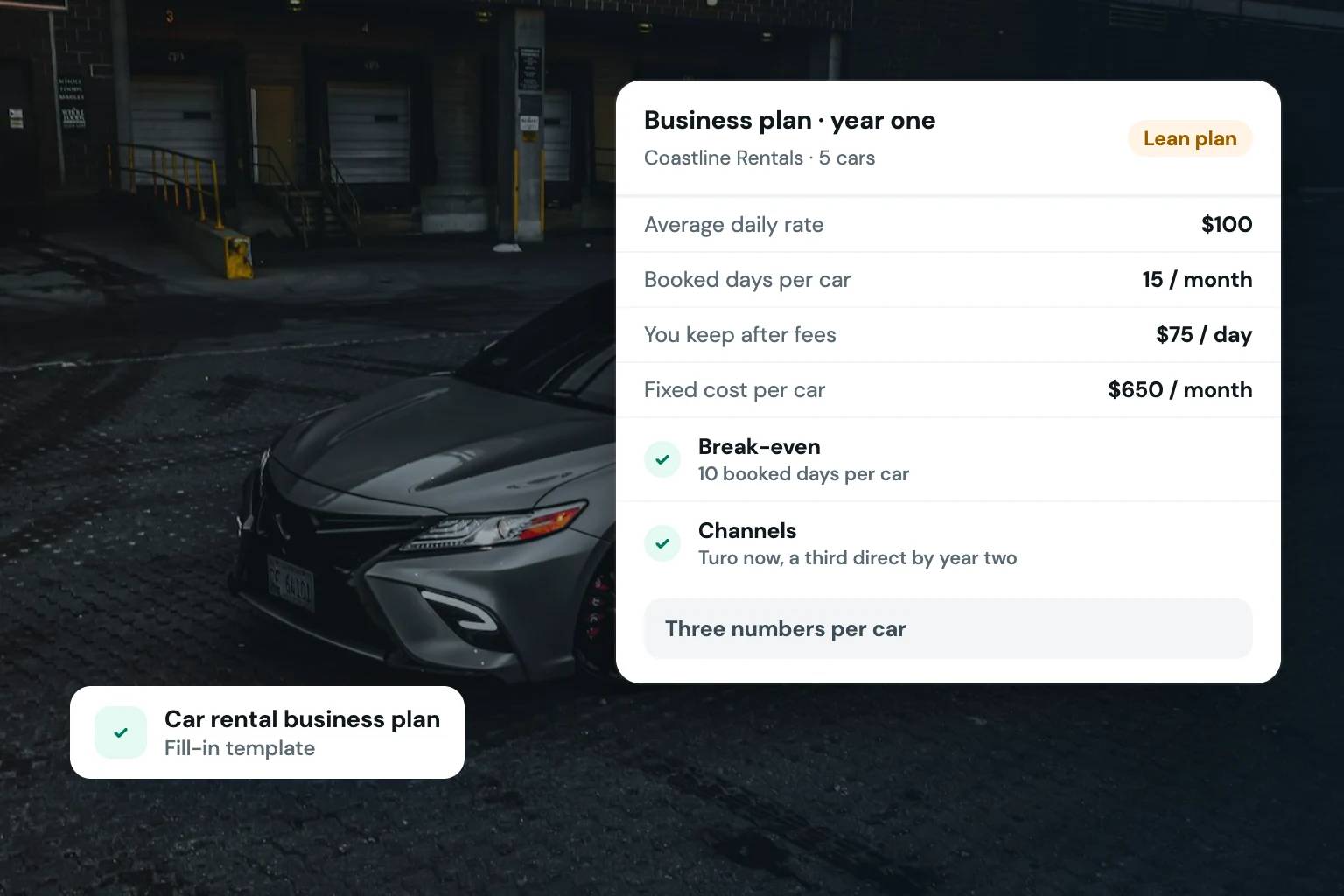
Revenue per car per month = daily rate × booked days − platform fees. For example, in our 5-car math, five cars at $100 a day, booked about half the month, bring in $7,500 of trips, and Turo keeps $1,500 to $2,250 of that depending on the plan. Our free Turo fee calculator runs this for every plan.
Costs per car per month: the loan payment or depreciation, insurance, maintenance and tires, cleaning, parking, card fees and software. Don’t forget the cash cushion: a car in the body shop still has a payment due. What it costs to run a small car rental business lists the usual lines.
Break-even booked days per car = fixed monthly cost ÷ (what you keep per day − variable cost per day). With example numbers: a car costing $650 a month in loan, insurance and parking, where you keep $75 a day after fees and spend $10 a day on cleaning and wear, breaks even at 10 booked days a month. Every booked day after that is profit before tax. Swap in your own numbers, or use the rental car profit calculator to do it for a whole fleet.
Keep the plan honest after launch
A plan is a forecast. Once you’re running, compare it with what happened every month: booked days, revenue and costs per car. In Fleetwire, your bookings, invoices and payments sit in one place, and the Orders export gives your accountant a transactions ledger and sales tax report, so checking the plan against reality takes minutes. Taxes are their own planning item; see Turo taxes for hosts and insurance for direct rentals for the two costs hosts most often underestimate.
Start a free trial when you’re ready to take bookings on your own site.
FAQ
How do I write a business plan for a car rental business?
Start with a one-page lean plan: who rents from you, why, how they find you, and what each car costs and earns. If you’re applying for a loan, expand it into the full outline the SBA recommends, with monthly projections for the first year. The fill-in prompts above are written for rental fleets.
What are the 7 parts of a business plan?
Lists vary. The SBA’s traditional outline has eight common sections: executive summary, company description, market analysis, organization and management, service or product line, marketing and sales, funding request, and financial projections. Seven-part lists usually fold the funding request into the financials. The SBA says to use the sections that make sense for your business.
Do I need a business plan to start on Turo?
Turo doesn’t ask for one. You’ll want one if you’re borrowing to buy cars, adding cars beyond the first one or two, or planning to take bookings yourself. Even then, a one-page plan and a per-car spreadsheet go a long way. Turo also offers a free Business Planner tool for hosts.
How do I start a car rental business?
Our guide to starting a car rental business walks through six stages, from your first car on Turo to taking direct bookings. The business plan is the paperwork for stage one.
Which car rental business is most profitable?
It depends on your costs and your market more than the business model. Cheaper cars tend to return more per dollar, and specialty vehicles earn more per day. See best cars for Turo, then run your numbers in the profit calculator.
Is there a car rental business plan PDF?
You can print this page or save it as a PDF from your browser: the lean plan table and the section prompts are built to be filled in. The SBA also publishes example traditional and lean plans to download.
Sources
This is general information, not legal, tax or financial advice. Talk to an accountant or attorney about your business structure, taxes and financing.