Part of our guide: How to start a car rental business (without quitting Turo)
Every “best cars for Turo” list leans on the same source: Turo’s own earnings data. It’s useful, but it’s a few years old, it assumes a cheap loan, and it leaves out most of what a car costs to run. Here’s what Turo’s numbers actually say, what they don’t, and how to pick a car that earns in your market.
The short version. In Turo’s ranking, cheap economy cars like the Fiat 500 and Kia Rio return the most relative to their loan cost, while big SUVs, vans and luxury cars earn the most dollars. Turo itself says there’s no single best car: the right one fits the guests in your area. Before you buy, check Turo’s age and mileage rules, get an insurance quote, and run the numbers with your own costs.
What Turo’s data shows
Turo ranks cars by return on investment: average annual Turo earnings divided by the car’s estimated annual loan payments. It splits them into three price buckets by base MSRP. The top three in each, from Turo’s top-earning cars page:
| Car | Turo’s ROI | Avg. annual earnings | Est. annual loan cost |
|---|---|---|---|
| Economy: $10K–$30K MSRP | |||
| Fiat 500 | 178.2% | $7,009 | $2,519 |
| Chrysler Voyager | 150.1% | $10,438 | $4,174 |
| Kia Rio | 138.5% | $7,177 | $3,009 |
| Mid-range: $30K–$50K MSRP | |||
| Audi S5 Cabriolet | 94.1% | $17,764 | $9,154 |
| Alfa Romeo Stelvio | 79.6% | $11,442 | $6,371 |
| Cadillac CT5 | 73.4% | $11,065 | $6,382 |
| Upscale: $50K–$75K MSRP | |||
| Porsche Panamera | 129.6% | $29,741 | $12,953 |
| Porsche 718 Boxster | 72.5% | $17,738 | $10,280 |
| Lincoln Navigator L | 70.5% | $23,598 | $13,841 |
Two patterns stand out. Cheaper cars return more per dollar. Turo says every top-10 economy car earned more than double its estimated loan payments, partly because lower prices bring frequent and longer trips. Pricier cars earn more dollars. A Panamera averaged over four times what a Fiat 500 earned in a year, but it costs about five times as much to finance.
Read the fine print. Turo’s ranking uses trips from October 2017 to October 2021, for model years 2018 and newer, in its 14 biggest US markets. Earnings are after Turo’s share, but they don’t include the down payment, cleaning, parking, maintenance, damage claims or depreciation. The loan math assumes 4.5% interest over 60 months with 10% down. Turo says results vary by car, host, market and season, and past performance doesn’t predict future results.
Match the car to your guests
Turo’s October 2026 guide makes the same point several times: there’s no single best make or model, because what earns depends on who books in your area. Its breakdown:
| If your guests are… | Car type | Turo’s examples |
|---|---|---|
| Families, road trips, groups | Large SUVs, minivans, passenger vans | Suburban, Expedition, Odyssey, Pacifica |
| Commuters and longer stays | EVs and plug-in hybrids | Tesla Model 3 and Model Y, Ioniq 5 |
| City driving, everyday errands | Compact sedans and hatchbacks | Corolla, Civic, Kia Rio, Mazda3 |
| Airports and tourist towns | Reliable mid-size sedans and SUVs | Camry, CR-V, Outback |
| Monthly renters | Fuel-efficient cars and EVs | Prius, Model 3, Ioniq 5 |
The same guide calls large SUVs, passenger vans and “Super Deluxe” sedans the top earners in dollars, with city-by-city estimates that change every year. Treat those as a sign of where demand is, not a forecast for your car. Then search Turo in your own city: if every listing near you is a Model 3, a minivan may have less competition.
What the earnings lists leave out
A car that earns twice its loan payment can still lose money. These are the costs no ranking includes, and the ones that decide whether a car pays off:
- Depreciation. Usually the biggest cost of a rental car, and it speeds up with rental miles.
- Insurance. Turo’s protection plan covers trips, not the time between them. Your own policy is extra.
- Maintenance and wear. Tires, brakes, oil, and Turo’s annual safety inspection where it applies.
- Cleaning, parking and delivery. Small per trip, large per year, especially with airport delivery.
- Claims and downtime. A car in the body shop earns nothing, even when a claim pays for the repair.
- Today’s loan rate. Turo’s math assumed 4.5% over 60 months with 10% down. Use the rate you would actually get.
That’s why the same car can be a great buy for one host and a mistake for another. The only numbers that matter are yours.
How to pick a car for your market
- Search Turo in your own city. Look at what’s listed, what’s booked and what’s missing. A gap in your market beats a car on someone else’s list.
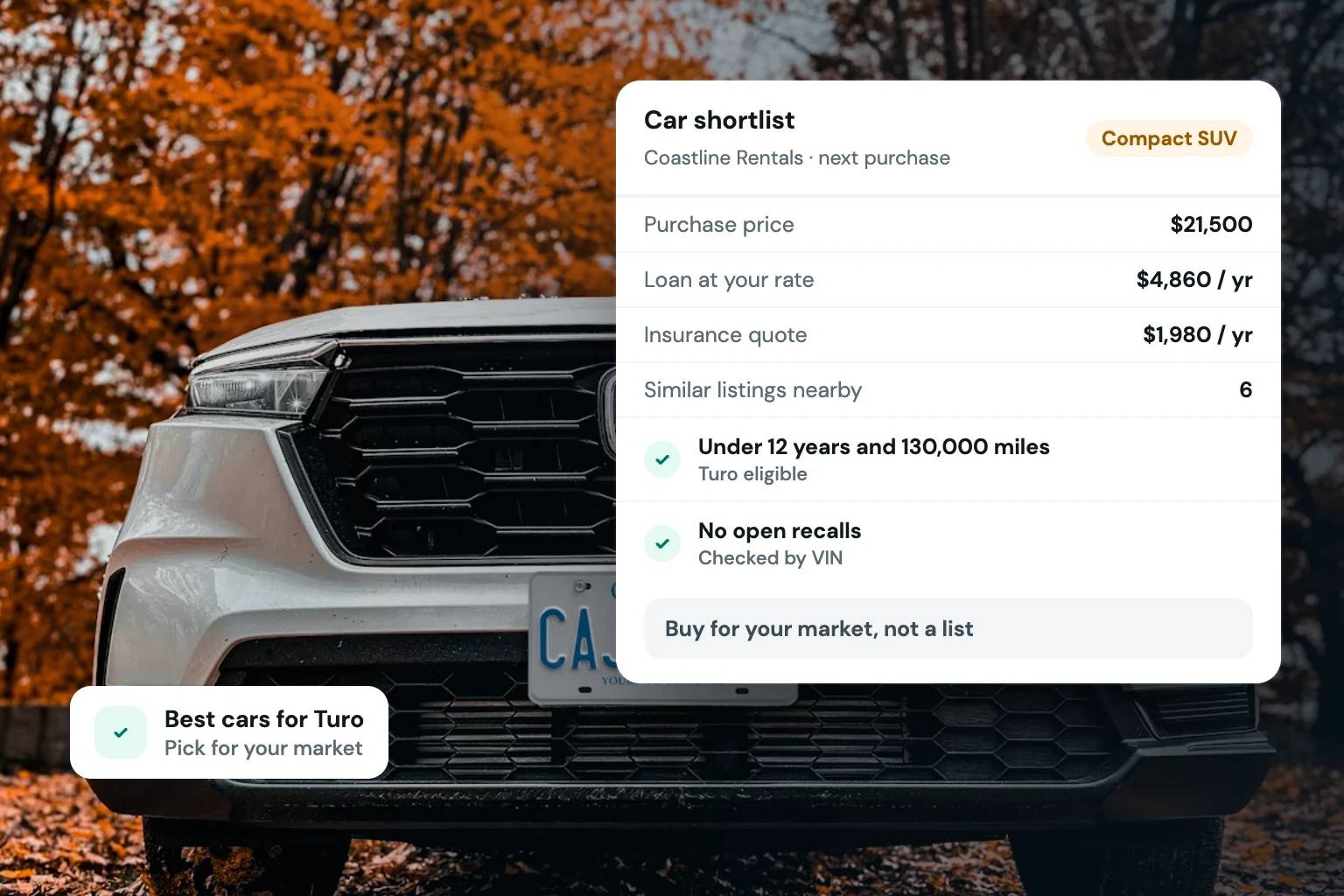
- Check Turo’s vehicle rules before you buy. Under 12 years old, under 130,000 miles, worth $200,000 or less, clean title. Our requirements guide covers the exceptions.
- Get an insurance quote for that exact car. A sporty or high-value car can cost far more to insure, and some insurers won’t cover car sharing at all. See insurance for Turo hosts.
- Run the numbers on your costs. Put the price, your loan rate, insurance, a realistic number of booked days and Turo’s cut into our profit calculator and Turo fee calculator.
- Check recalls on the model. An open recall can take a car off the road. Our free recall check looks up any VIN or model.
- Plan the exit. Know what the car will be worth at 130,000 miles or 12 years, and whether you’ll sell it or keep renting it yourself.
When a car ages out of Turo
A car that’s earning well doesn’t stop being useful at 12 years or 130,000 miles. Turo’s limits don’t apply to bookings you take yourself, so many hosts keep older, paid-off cars renting on their own booking site. Check what your insurer allows first.
Fleetwire gives you that booking site, with ID checks, deposits and e-signed agreements built into checkout, and calendar sync so the cars you still list on Turo never get double-booked. Start a free trial.
FAQ
What is the most profitable vehicle on Turo?
In Turo’s own ranking, the Fiat 500 had the highest return on investment, earning on average about 178% of its estimated annual loan cost. That ranking uses trips from October 2017 to October 2021, and it doesn’t count cleaning, maintenance, depreciation or other running costs. In absolute dollars, the larger and pricier cars earn more per year. See Turo’s top-earning cars page.
What is the best vehicle to rent on Turo?
Turo’s 2026 guide says there is no single best make or model. The best car is the one that fits the guests in your area: a three-row SUV near family vacation spots, an EV for longer stays, a compact for city errands.
What cars get booked the most on Turo?
Turo doesn’t publish a most-booked list. Its 2026 guide says compact, fuel-efficient cars see steady demand from guests who need everyday transportation, and its ROI analysis found that cheaper cars tend to get both frequent and longer trips.
Is it worth buying a car to put on Turo?
It can be, if the numbers work for that car in your market after insurance, depreciation, maintenance and Turo’s share. Run them before you buy, not after. Our free profit calculator takes your price, loan, insurance and expected booked days.
Is Turo profitable?
For some hosts, yes, and for others it only covers the car payment. The difference is usually the car’s cost, how many days it’s booked, the plan you’re on and your running costs. The 5-car math shows how fees add up as a fleet grows.
What happens when my car gets too old for Turo?
Turo won’t list cars over 12 years old or 130,000 miles (a car that passes 130,000 after it’s listed can stay if it’s in excellent condition). Those limits don’t apply to bookings you take yourself, so some hosts keep older cars earning on their own booking site, within what their insurer allows.
Sources
- Turo: Top-earning cars on Turo, with methodology (read November 20, 2026)
- Turo blog: Best cars for earning extra income on Turo, October 7, 2026 (read November 20, 2026)
Earnings figures are Turo’s and are quoted as published on the dates listed. They’re estimates, not a promise of what any car will earn. Fleetwire isn’t affiliated with Turo.