If you already rent cars on Turo, you've done the hardest part of starting a car rental business. You have cars, renters, reviews and a routine for handing over keys. What you don't have is a business of your own: Turo owns the customer, sets the rules and keeps 10% to 30% of every trip.
Starting your own rental business doesn't mean quitting Turo. It means adding a channel you control, your own booking site with your own prices and terms, and growing it with renters who find you directly. Each stage below covers what to decide and links to the guides that go deeper.
- Stage 1Decide whether direct pays
- Stage 2Set up the business and its protection
- Stage 3Build your booking site
- Stage 4Take payments and deposits
- Stage 5Run Turo and direct side by side
- Stage 6Get your first direct bookings
Turo prohibits payments outside Turo for Turo trips. Doing it can void the trip's protection and get you removed from the platform, per its gray market policy. Build your direct business from renters you find, and read Turo's terms before contacting a guest you met there about a direct booking.
Stage 1Decide whether direct pays
Turo's US earnings plans let you keep 70%, 80% or 90% of the trip price. The higher your share, the more damage you carry yourself: $250, $1,500 or $2,750 per claim. On a direct booking you keep the whole price and pay three costs instead: card processing, your own insurance, and booking software.
For most hosts the answer isn't "move everything." It's "what is each direct rental day worth?" On the 70% and 80% plans, a direct day usually keeps noticeably more, even after insurance. On the 90% plan, fees alone don't make the case, and the reason to go direct is control over your renters and your risk. Run your own numbers before you spend anything.
Stage 2Set up the business and its protection
On Turo, the platform is the business: its terms, its protection, its renter checks. On your own bookings, those are yours to set up. Start the slow parts first, because they take days while the software takes hours.
- The business. Most operators form an LLC, get an EIN, open a business bank account, and check local business license and sales tax rules. It keeps rental money separate from yours, and many insurers expect it.
- Insurance. Turo's protection applies only to Turo trips, and personal auto policies usually exclude renting a car out. You'll need coverage written for renting to the public, plus verified insurance from each renter.
- A rental agreement that says who can drive, what the deposit covers, and who pays for damage, tolls and late returns. Have an attorney in your state review it.
- Renter checks: ID verification and an insurance check before every pickup, so you aren't handing keys to someone you've only texted.
- Safety recalls. Turo checks your VIN for open recalls. Off Turo, nobody does unless you do.
This is general information, not legal or insurance advice. Rules vary a lot by state.
- Turo insurance for hosts, and what replaces it on direct rentals
- Car rental agreement: what to include (14-section checklist)
- How to verify a renter’s driver’s license and insurance
- How to verify renter identity before pickup
- Open recalls on a rental car: what hosts are on the hook for
- Free recall check for your fleet
Stage 3Build your booking site
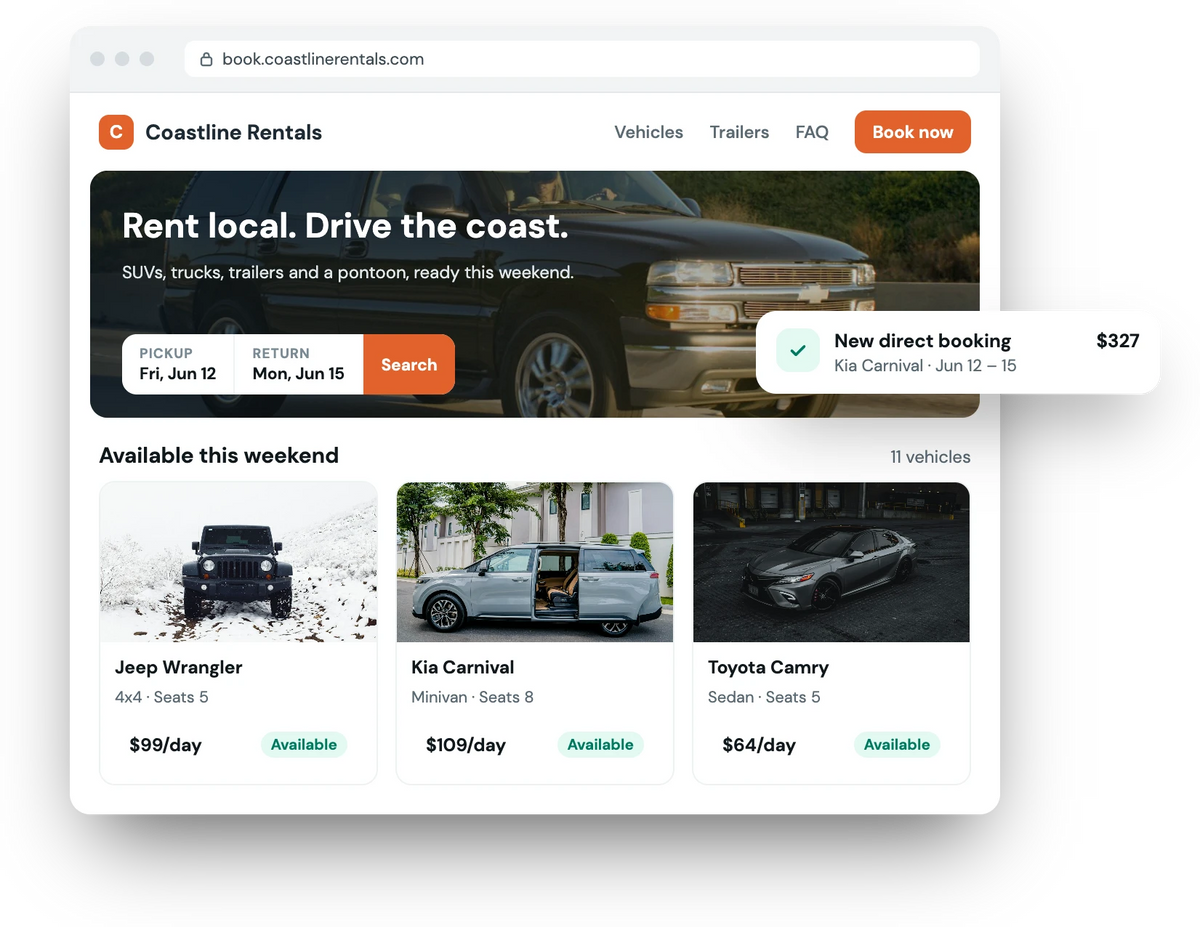
Your booking site is where a renter sees your cars, checks real availability and books without texting you. It needs listings with photos and rates, a live calendar, a checkout that takes payment, and the renter checks from stage 2 built into it. A site that only collects inquiries just moves the back-and-forth from Turo's inbox to yours.
Put it on your own domain with your own name and logo. Renters who search for your business should find your site, not just your Turo listing.
Stage 4Take payments and deposits
Take payment through a real card processor, not Venmo or Zelle. It looks more legitimate, gives you receipts and refunds, and lets you hold a deposit. A card hold reserves the deposit on the renter's card without charging it, so there's nothing to refund when the car comes back clean. Holds expire after about seven days, so longer rentals need them renewed.
Decide your deposit amount (often your insurance deductible), your cancellation policy, and what you'll charge after the trip for fuel, tolls, cleaning and damage. Then put all of it in the agreement.
Stage 5Run Turo and direct side by side
The safest way to start is hybrid: keep your Turo listings live and add direct bookings next to them. The risk in that setup is the double booking, so a car booked on Turo must be blocked on your site. Import your Turo trips with a calendar sync. The other direction is manual, because Turo doesn't accept bookings from outside software: when a car is booked direct, block those dates on Turo yourself.
Expect the direct share to start small, maybe one booking in ten, and grow as repeat renters and referrals find you. You're moving the ratio a little every month, not switching overnight.
Keep the photo routine you use on Turo: timestamped photos of all four sides, wheels, windshield, interior, odometer and fuel or charge at pickup and return. On direct bookings those photos are your only evidence in a damage dispute.
Stage 6Get your first direct bookings
Direct bookings come from demand you build yourself:
- Google. A Google Business Profile and a site that matches what renters search in your city ("SUV rental in [city]", "Tesla rental near me").
- Your own repeat renters. Every direct renter goes on your customer list, so their next trip and their referrals come straight to you.
- Local partners. Hotels, short-term rental hosts, realtors, body shops, travel-nurse agencies and event venues all meet people who need a car.
- Referrals. A small discount for a renter who sends a friend costs less than any marketplace fee.
Renters who met you on Turo are where the rules get strict. Keep their trips, and anything about payment, on Turo.
Key takeaways
- Don't quit Turo. Add a direct channel and grow it with renters you find yourself.
- Start the slow parts first: LLC, insurance quotes, an attorney-reviewed agreement.
- Rebuild what Turo did for you: renter checks, deposits, signed terms, recall checks.
- Sync Turo trips onto your calendar, and never take a Turo trip or its payment off the platform.
Frequently asked questions
Can I start a car rental business while staying on Turo?
Yes, and most hosts should. Keep Turo for discovery, sync its trips onto your own calendar so a car can't be booked twice, and take direct bookings from renters you found yourself. What Turo prohibits is taking a Turo trip, or its payment, off the platform.
How many cars do I need before direct bookings pay?
Direct pays from the first car when the booking comes from your own demand, because you keep the share Turo would have taken. It starts to matter as a business at around five cars, when repeat renters and referrals add up. The 5-car math works through it.
What insurance do I need without Turo?
Turo's protection only applies to Turo trips. For direct rentals you need a policy that covers renting to the public, usually a commercial fleet policy, plus verified coverage from the renter and a deposit for the deductible. Our insurance guide covers the layers and the questions to ask a broker.
Do I need an LLC to rent out cars?
It isn't always required, but most operators form one so the rental business is separate from their personal finances, and many commercial insurers expect a business entity. Ask an attorney and accountant what your state requires.
How long does it take to set up?
The booking site, agreement, verification and payments can be live in a day. What takes longer is waiting on other people: your LLC filing and insurance quotes. Start those first.
What does it cost to start?
Beyond the cars, budget for insurance, business registration and software. Fleetwire starts at $24 a month billed yearly ($34 monthly), with no setup fee and no cut of your bookings. Our startup costs guide breaks the rest down.
Fleetwire runs stages 3 to 5 in one place: a booking site on your own domain, ID and insurance checks, deposits held on the renter's card, and Turo trips on the same calendar. Plans start at $24 a month billed yearly, with e-signed agreements from the Standard plan. If you'd rather not set it up yourself, the Launch Package does it for you.